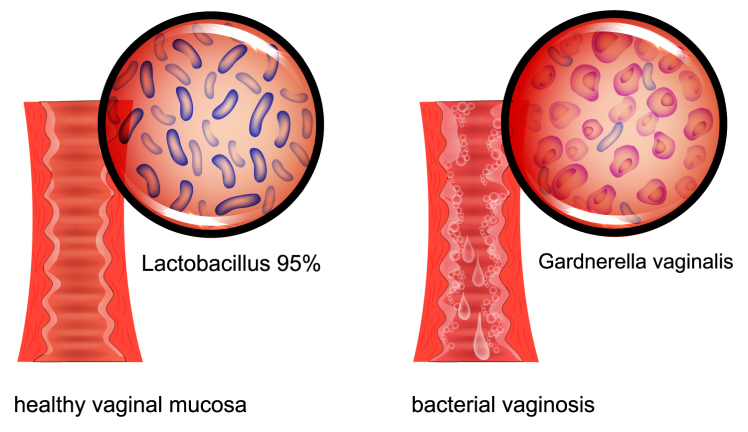
BV is caused by an imbalance of naturally occurring bacterial flora, the usual bacteria found in a woman’s vagina. Why this happens is not clear. It is different from candidiasis, a yeast infection, or Trichomonas vaginalis (T. vaginalis), or trichomoniasis, also known as trich. These are not caused by bacteria
The role of bacteria
All parts of the body have bacteria, but some are beneficial while others are harmful. When there are too many harmful bacteria, problems can arise. The vagina contains mostly “good” bacteria and some harmful bacteria. BV occurs when the harmful bacteria grow in numbers. A vagina should contain bacteria called lactobacilli. These bacteria produce lactic acid, making the vagina slightly acidic. This prevents other bacteria from growing there. Lower levels of lactobacilli may cause the vagina to become less acidic. If the vagina is not as acidic as it should be, this can give other bacteria the chance to grow and thrive. However, exactly how these harmful bacteria are linked with BV is not known.
Risk factors
Any woman can develop BV, but some behaviors or activities can increase the risk.
These include:
Douching, or using water or a medicated solution to clean the vagina
Having a bath with antiseptic liquids
Having a new sex partner
Having multiple sex partners
Using perfumed bubble baths, vaginal deodorants, and some scented soaps
Smoking
Washing underwear with strong detergents
BV cannot be caught from toilet seats, bedding, swimming pools, or touching objects.
Symptoms
BV may be present without symptoms, but if symptoms occur, they include vaginal discharge, burning, and itching.
Play Video
Vaginal discharge may:
Be watery and thin
Be gray or white in color
Have a strong and unpleasant smell, often described as fishy
Less commonly, there may be:
a burning sensation during urination itching around the outside of the vagina
Between 50 and 75 percent of women with BV have no symptoms. BV alone is not considered harmful, but complications can arise.
Complications
Complications that have been linked to BV include a higher risk of:
HIV infection, as BV increases susceptibility to the virus
STIs, such as the herpes simplex virus, chlamydia,
gonorrhea, and human papilloma virus (HPV)
post-surgical infection, for example, after a termination or
a hysterectomy
Possible complications of BV during pregnancy include:
Early, or preterm, delivery
Loss of pregnancy
The amniotic sac breaking open too early postpartum endometritis, an irritation or inflammation of the lining of the uterus after delivery tubal factor infertility, caused by damage to the fallopian tubes, which connect the ovaries to the uterus
Chorioamnionitis, an inflammation of the membranes surrounding the fetus, known as the chorion and the amnion
In-vitro fertilization (IVF) may be less likely to succeed if a woman has BV.
BV also increases the risk of pelvic inflammatory disease (PID), an infection and inflammation of the upper female genital tract that can have severe consequences, including infertility.
Treatment
BV often clears up without treatment, but women with signs and symptoms should seek treatment to avoid complications.
Treatment may not be needed if there are no symptoms. Sometimes BV can appear and disappear for no apparent reason.
If there is an abnormal vaginal discharge, it is important to see a doctor as soon as possible. A doctor can diagnose BV and rule out other infections, such as gonorrhea or trich.
Untreated BV can also lead to complications, especially during pregnancy.
Some doctors recommend giving BV treatment to all women who will be undergoing a hysterectomy or termination, before the procedure, regardless of symptoms.
Male partners do not usually need treatment, but they can spread BV between female sex partners.
Antibiotic medication
Antibiotics are effective in up to 90 percentTrusted Source of cases, but BV often comes back again within a few weeks.
Metronidazole is the most common antibiotic for BV.
Oral antibiotics are normally effective against BV.
Metronidazole reacts with alcohol. The combination can make the patient feel very ill. Individuals taking metronidazole should not consume alcohol for at least 48 hours afterward.
Clindamycin is an alternative antibiotic. It may be used if metronidazole is not effective, or if the infection recurs.
When taking clindamycin, barrier contraception methods, such as latex condoms, diaphragms, and caps may be less effective.
Tinidazole is another antibiotic that is sometimes used to treat BV if metronidazole does not work or if BV recurs. It is taken by mouth as a single dose. Alcohol must be avoided when taking this medication.
If the following happens, further tests will be needed:
Symptoms persist
Symptoms go away but come back
The patient is pregnant
If symptoms resolve after completing a course of antibiotics, the woman will not have to be tested for BV again.
Recurring symptoms
Around 30 percent of women whose symptoms disappear with treatment will have a recurrence within 3 months, and 50 percent will have a recurrence within 6 months.
Other Treatment Options:
Prebiotics, To restore Microbiome (Good bacteria) inside vagina by using prebiotics. Many of these microbes are type of bacteria called lactobacilli. This bacteria help keep the vagina healthy and free of infection.